A Homeowner-Friendly Guide to Comfort, Savings, and Smarter Living
If you’ve owned a home for a while, there’s a good chance you’ve already interacted with a thermostat hundreds—maybe even thousands—of times. It’s one of those devices that sits quietly on your wall and dictates how comfortable you feel throughout the year. And while it may not be the flashiest piece of equipment in your home, it has the huge job of keeping your heating and cooling systems running efficiently.
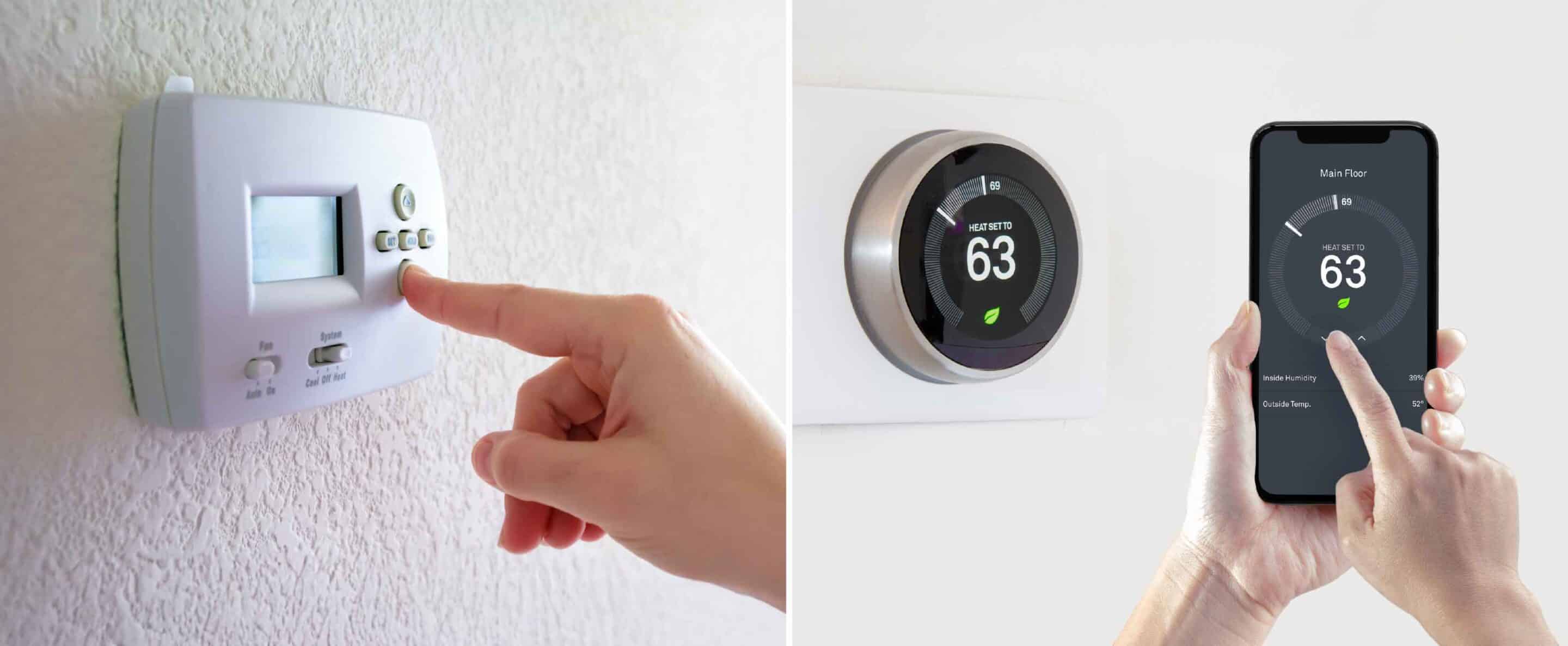
Over the past decade, thermostats have gone from simple temperature dials to intelligent, learning devices that can practically think for themselves. If you’ve ever wondered whether upgrading to a smart thermostat is actually worth it—or if your current traditional thermostat is doing enough—this blog breaks it all down in plain language.
Let’s explore what separates traditional thermostats from smart thermostats, how each one works, and which option makes the most sense for different households.
1. What Is a Traditional Thermostat?
Traditional thermostats come in two main types:
- Manual thermostats (think old-school dial or slider models)
- Programmable thermostats (digital screens with basic scheduling)
How Manual Thermostats Work
A manual thermostat does exactly what it sounds like—you manually set the temperature, and it tells your HVAC system when to turn on and off. These thermostats use physical components like bimetallic strips or mercury bulbs to measure temperature and activate your furnace or AC.
They’re extremely simple and have been around for decades. They don’t save settings. They don’t learn your habits. They don’t talk to your phone. But they do the job.
How Programmable Thermostats Work
Programmable models are a step up. They let you pre-set temperatures based on time and day, like:
- Turning the temperature down at night
- Warming up the home before you wake
- Reducing heating or cooling while you’re at work
Programmable thermostats can save you money, but only if you actually program them—and surprisingly, many homeowners never get around to it or find the menus too confusing.
2. What Is a Smart Thermostat?
A smart thermostat takes everything a programmable thermostat can do and builds on it with technology that makes heating and cooling effortless.
Smart thermostats connect to Wi-Fi, allowing you to control them from your smartphone, tablet, or even your voice assistant (Alexa, Google, Siri).
Popular smart thermostat brands include:
- Nest
- ecobee
- Honeywell T9 or T10
- Daikin One+ (very relevant for HVAC installs)
Key Features of Smart Thermostats
Here are some of the standout features homeowners love:
✔ Remote control through phone apps
Not home? No problem. Adjust your thermostat from anywhere.
✔ Learning capability
Some smart thermostats track your routines and automatically adjust temperatures to match them.
✔ Energy usage reports
You’ll get monthly insights into how much energy your HVAC system uses and recommendations on how to save more.
✔ Geofencing
Your thermostat detects when you leave the house and adjusts temperatures to save money—then returns to comfort mode when you’re heading home.
✔ Smart home integration
Lights, thermostats, cameras, doorbells—smart devices can all work together.
✔ Room sensors
Instead of basing the temperature on just one room, smart thermostats can use sensors around your home to even out hot/cold spots.
3. Key Differences Between Traditional and Smart Thermostats
Let’s break down the biggest differences in a simple, human way.
A. Convenience & Ease of Use
Traditional thermostats:
- You must physically walk over and adjust them.
- Programmable ones require learning menus—not everyone does this.
- If you go on vacation and forget to change settings… well, too late.
Smart thermostats:
- Adjust your home’s temperature from your phone, wherever you are.
- Vacation mode? Just tap it on your app.
- No more remembering—your thermostat can handle routines for you.
Winner: Smart thermostats—by a mile.
B. Energy Savings
Traditional thermostats:
- Can save money, but only if programmed properly.
- If you forget to adjust it, energy is wasted.
- Doesn’t track humidity, run times, or efficiency.
Smart thermostats:
- Automatically reduce heating/cooling when you’re not home.
- Optimize temperature swings to keep your system running efficiently.
- Provide energy history reports so you can see exactly how much you’re saving.
On average, many homeowners save 10%–20% annually after switching to a smart model—sometimes more.
Winner: Smart thermostats again.
C. Comfort & Consistency
Traditional thermostats:
- Measure only the temperature of the room they’re installed in.
- If that room is warmer or cooler than others, your whole home pays the price.
- No ability to adapt to drafts, sun, humidity, or lifestyle.
Smart thermostats:
- Use room sensors to balance hot and cold zones.
- React to humidity and outdoor temperature data.
- Learn your comfort preferences (for example: cooler at night, warmer in the morning).
- Provide more precise temperature control.
If you’ve ever had that one freezing bedroom or that one boiling hot upstairs hallway, a smart thermostat helps eliminate that.
Winner: Smart thermostats.
D. Price & Installation
Traditional thermostats:
- Very inexpensive—manual models cost $25–$60.
- Programmable ones range from $50–$120.
- Easy to install for most HVAC companies or even homeowners.
Smart thermostats:
- Usually cost between $160–$350 depending on brand.
- May require a professional installation, especially if you have:
- Heat pumps
- Multi-stage furnaces
- Communicating systems
- Humidifiers
- HRVs/ERVs
- Older homes without a “C-wire”
Winner: Traditional thermostats (on price)—but smart thermostats make up the cost in energy savings.
E. Long-Term Benefits & Technology
Traditional thermostats:
- Very reliable.
- Simple and long-lasting.
- But no new features or improvements… what you see is what you get.
Smart thermostats:
- Get software updates that improve features over time.
- Can be integrated into your future home tech.
- Offer alerts for:
- Filter changes
- Humidity changes
- Temperature spikes
- HVAC faults (in advanced models like Daikin One+)
Winner: Smart thermostats—future-proof and feature-rich.
4. Real-World Examples: What Does This Look Like for Homeowners?
Scenario 1: You Forget to Turn Down the Heat Before Leaving for Work
Traditional thermostat:
Your home stays warm and comfortable… but empty. Wasted energy equals wasted money.
Smart thermostat:
Your phone leaves home, the thermostat detects it, and automatically drops the temperature.
When you’re heading home, it warms back up before you arrive.
Scenario 2: You’re on Vacation
Traditional thermostat:
If you forgot to change it beforehand, it’s too late.
Smart thermostat:
Log into the app from anywhere in the world and adjust settings instantly.
Scenario 3: Your Bedrooms Are Always Too Hot or Too Cold
Traditional thermostat:
You can’t fix this without adjusting the whole house.
Smart thermostat:
Room sensors can prioritize the bedroom temperature instead of the hallway.
Scenario 4: You Want Lower Energy Bills Without Sacrificing Comfort
Traditional thermostat:
Savings depend entirely on how often you manually adjust.
Smart thermostat:
Built-in energy optimization reduces bills automatically.
5. Are There Any Downsides to Smart Thermostats?
Smart thermostats offer massive advantages—but there are a few things to consider.
They cost more upfront.
While they usually pay for themselves in under two years, the initial cost is higher than a traditional thermostat.
They rely on Wi-Fi.
If your internet goes out, they still work—but you lose app control temporarily.
Not all smart thermostats work with every HVAC system.
Some older systems or advanced communicating systems require professional installation or brand-matched thermostats (common with Daikin, Amana, Carrier, etc.).
Learning features don’t suit everyone.
Some people prefer temperature control without automation or adjustments made by the thermostat itself.
Most homeowners, however, find the convenience and savings well worth the upgrade.
6. Who Should Stick With a Traditional Thermostat?
A traditional thermostat might be your best choice if:
- You prefer simplicity over features
- You rarely use your phone for home devices
- You’re on a tight budget
- You have a rental unit where tenants come and go
- You hardly ever adjust your temperature
- Your home has older wiring and you prefer not to update it
Traditional thermostats are dependable, straightforward, and affordable.
7. Who Should Upgrade to a Smart Thermostat?
A smart thermostat is ideal if you:
- Want to save money on your heating and cooling bills
- Enjoy modern technology
- Like being able to control your home remotely
- Have fluctuating schedules
- Want room-by-room comfort
- Want insight into your energy usage
- Want voice control or smart home integration
- Own a high-efficiency HVAC system that benefits from precise control
Smart thermostats pair especially well with heat pumps, two-stage furnaces, variable-speed systems, and modern HVAC equipment.
8. The Final Verdict: Which One Is Better?
Both thermostat types have their place, and the right choice depends on your lifestyle and priorities.
Traditional Thermostats Are Best For:
- Budget-conscious homeowners
- People who want simple temperature control
- Homes without Wi-Fi or with very old wiring
Smart Thermostats Are Best For:
- Anyone wanting long-term energy savings
- Tech-friendly households
- Homeowners with busy, unpredictable schedules
- People who want maximum comfort and efficiency
- Those investing in newer HVAC equipment
If you’re already running a high-efficiency furnace, air conditioner, or heat pump, a smart thermostat can unlock even better performance and comfort from your system.
9. Ready to Make the Switch? We Can Help.
Whether you’re thinking about:
- A basic uniform thermostat
- An advanced programmable model
- Or a fully smart thermostat with learning and room sensors
Your HVAC system may require specific types of thermostats to work properly. At Able Air Conditioning & Heating, we take care of the entire process—from recommending the right thermostat to installing it and ensuring your system is optimized.
If you’re not sure which thermostat is best for your home, we’re happy to walk you through your options.
Need help choosing or installing a thermostat?
Reach out today!—we’ll make sure you get a setup that keeps your home comfortable and efficient year-round.
With over 20 years of experience in the HVAC industry, Able Air Conditioning & Heating proudly serves homeowners and businesses in Kitchener, Waterloo, Cambridge, Guelph, and nearby areas. Our award-winning team of licensed technicians is dedicated to providing reliable equipment and service our clients can trust.
Follow us on Facebook and Instagram for expert tips, helpful resources, and our latest promotions.